My eyebrows are in one time zone, my legs are in the last one, and my torso shut off. I also don't think I got much sleep. So apologies if I don't give these bullets points the lengthy treatment they deserve.
-Amar'e, Amar'e, and more Amar'e. At the Awl, I turn the looking glass back on myself. I somehow neglected to mention the issue of conversion, something Eric Freeman and my brother have raised previously. They point to the convert's over-enthusiasm for ritual and all else that belongs in Judaism for Dummies, much like what we see with Stoudemire (albeit less cryptically). As well they should; it's their job. Here's the thing: conversion is a process, a course by which one arrives at the right to call himself a Jew. Amar'e ignored that part—the whole humility, learning and growing part—and has gone right off the deep end. So no, not the same thing.
-Yesterday, Henry brought up his year abroad in Tibet, and suggested we view Amar'e's summer fun in the same developmental light. Since, after all, Amar'e never went to college and had a chance to grow. Now, I don't see any one-and-dones taking a semester abroad, or necessarily getting all they can from the college experience. But certainly, some guys—Kevin Durant, for instance—have shown enthusiasm for their courses, mixing with students, and just generally getting something out of a year on campus. Jay Caspian Kang would like to nominate John Henson for this honor.
Pacific Rims reading and book signing Tuesday, August 3, 6:30 pm Eastwind Books of Berkeley 2066 University Avenue, Berkeley, Calif.
Don't forget, Pacific Rims is the basketball book of the year, and Rafe seems like quite a hoot in his videos. I can also attest to his skills as an email correspondent. Show up or regret it forever!
Remember how Obama was elected President, and race no longer mattered in America? Here's some proof of that: West Virginia, coached by Bob Huggins, stocked with your usual Huggins players, is the latest underdog to inspire us all by taking the piss out of some uppity bunch of future lottery picks. Take that, John Wall. You were shut down, and while those lazy pros who would never heed a coach's scheme won't do it, West Virginia did. That's a mark of shame you'll bear forever. You couldn't take it to the limit, you are mortal, and your whole career will be a sham. DeMarcus Cousins, big dude, you can't handle the triple-team. But they won't throw that at you in the pros because they don't have the heart. Or too much ego. Those two are opposites.
Okay, let me stabilize myself, this boat is awfully rocky on the high seas of knowing what I need and want. West Virginia. What state says America more than that one? They've had the shit shot out of them for striking (I've seen Matewan for the acting!) and otherwise just die in the mines. But they keep on. Just like those Mountaineers. They refused to quit. You know why? Because they didn't need the NBA. They knew they might be playing the last game of their college careers. And since they were Huggins guys, they weren't getting a degree, either. Some might say "oh, they are just a bunch of wannabe NBA players, how can they be so noble?" The answer? They saw the light. They might as well be white people, the way they put Kentucky in their place. No way Ebanks declares this year, he's got unfinished business—and real men take care of business.
Coach Cal, shut the fuck up. Huggins made his team work, and drew up the X's and O's to make you sweat. Fucking Italian. Go back to Africa with your fucking team. I have to say, I never liked the Bearcats, or whatever the mascot of K-State is. But Huggin is the real deal. Appalachia is the heartland, just higher in the air. God's country. You lead a horse to water, but in the end, you need a real cowboy with his hands on the pump. Who was that black dude at the Tea Party rally? He was post-racial America. Go Mountaineers.
Jay Caspian Kang thinks John Henson should wear a muu muu and a fat guy hat. Follow him at twitter.com/maxpower51
In the summer after graduating from college, as part of my introduction to New York City, I took the A train down to the fabled West 4th Street basketball courts. All melancholy literary types are required to vividly remember, and then write about, their first encounters with The City and so I, too, can recall the heat that day and how it curled the edges of the wheat-pasted posters, pushing those sight-bending currents of hot air out of the subway exits. When I got to the courts, a middle-aged man with a camera around his neck told me that the league games had been delayed on account of the heat. Two lines of massive men in jerseys leaned up against the chain-link fence, occasionally looking up at the cloudless sky for some form of absolution, occasionally looking out at the court where some teenage kids were playing three on three. Two of the kids—how could I have not noticed?—were Asian. The game was a fundamental mess, just six guys scrambling around until one could find a dunking lane. After about five or six failed tries, one of the Asian kids managed to throw one down, eliciting a half-hearted chorus of oohs and aahs from the assembled crowd.
After a decently choreographed strut, this kid turned towards the chain-link fence and screamed, “Fuck yeah, n***a! You see me just dunk on that n***a?” Then, turning to his fellow Asian, he puffed out his chest and said, “N***a, this shit is over.”
No one the fence seemed to think this was strange or even worthy of comment. I, as they say, shat my pants.
Later, while wandering around an empty street in Flushing, I overheard two kids talking to one another in Korean. When I turned around, I saw that the kids were Black. They must have read the disbelief on my face for what it was—an ignorant outsider who was about to take a mental photo for his cultural tourism scrapbook—because they gave me a dirty look and crossed the street.
How did I, who, prior to moving to New York, had lived in Boston, North Carolina, Maine, Los Angeles and Seattle, make it to the age of twenty-three without having ever met an Asian-American kid who had grown up much differently from me? It’s true that I spent my childhood in nice, college towns and that my exposure to other Asian-Americans was limited to bi-monthly potluck dinners where all the alumni of my father’s high school would sit around and discuss God knows what, but I cannot help but wonder if this vacancy of identity might be the inevitable product of an entire generation of kids who were pushed directly into the structures of American success. Almost all the Asian-American kids who grew up with me have lost the ability to speak the native language of our parents. Our conversations with our grandparents are conducted in shouted commands and hand gestures. When we watch Old Boy or In the Mood for Love, we alternate between an unfamiliar, displaced pride in a connection we cannot quite delineate and the shame of having to access it through subtitles. This distance, at least for me, came from a desire to duck out from the traditional immigrant shelter of family and culture, and although it felt like a conscious choice at the time, I sometimes look around at my Asian-American friends who suffer from the same blind spots, and wonder if we might have had any say at all.
The truth is, I really don’t know.
If we, indeed, tell ourselves stories to live, the children of immigrants find themselves with the odd task of having to make one up as they go along. The stories projected upon me by my parents were episodic and told in a language of destinations. On the first page, my sister and I sit with the other pilgrims at the tabard. On the next page, we arrive at the Archbishop of Harvard’s door. What happens between those two markers is what a friend of mine once referred to as, “our leg in the blind sprint towards whiteness.” For him and me and the Asian-American kids I grew up with, the verbs and the adjectives in our narratives are disposable, circumstantial. What matters is the tyranny of nouns. If we see another Asian kid in the classroom or in the workplace, we simply assume that they got there the same way we did. Why bother asking? We are the Son-at-Harvard or Nephew-at-Columbia or the Son-who-works-at-Goldman or the Daughter-who-just-got-into-Stanford Medical School. When the weight of our common hyphens forces us into naming some other connection, we summon the only metanarrative we know, collected from our own memories and the commonalities we assume—fathers who are computer programmers or dry cleaners, insane mothers who only shop at Costco, piano lessons, Asian Church, pickled immigrant foods and 1500s on the SATs. For the most part, the metanarrative is enough.
The only stories that might make us pause and reconsider the paradigm of endings are the ones that provide us with an alien set of destinations—the stand-up comedian, the police chief, the mass murderer, the potential first round pick in the NBA Draft. In other words, those stories that belong to other races.
The lineage of Jeremy Lin isn’t found in racial pie charts or in the history of unlikely minorities in big-time sports. Yao, Ichiro, Wat Misaka and Eugene Chung are not his context. Neither is Hines Ward. Instead, to understand Jeremy Lin, we must look to Jin, the diminutive Chinese emcee from Jackson Heights who, for seven weeks, dominated the Battle Stage on BET’s 106th and Park.
As is true with Jeremy Lin, it mattered that Jin was American born, it mattered that he was competing in front of a mostly Black crowd on BET and it mattered that he was doing it with lines like, “If you make one joke about rice or karate/NYPD be in Chinatown searching for your body.” When Wyclef ruined his career by trying to turn him into a dance-happy club bopper, it mattered that Jin told ‘Clef to fuck off and went straight back to battle raps. More than all that, though, it mattered that Jin was legit, succeeding in the closest thing the music industry has to a meritocracy. And although Ruff Ryders probably envisioned some DOA Eminem experiment when they signed him, it mattered that Jin was better than the pigeonhole. He wasn’t a short-lived anomaly or even some college radio act fueled by a disastrous vision of cultural tourism. He was a battle rapper and even after his run on 106 and Park and his album flop, he kept appearing on battle DVDs and he kept winning.
Yes, he probably inspired a few Asian kids to see a rap career as a real possibility, but Jin represented more than another against-all-odds Asian success story. He wasn’t Connie Chung or Gary Locke or Jerry Yang, who, regardless of their intentions, confirm the country’s racial math. Jin went Black. In doing so, for those of us who were heeled on the mantra of assimilation, who have grown weary of the race towards whiteness, who have lived our lives in the strange space of identifying with hip-hop’s stories of racial oppression, but who have never really felt that our own stories could live up to the comparison, Jin’s bravado and skill offered an alternative interpretation of what it meant to be an Asian-American.
Try to understand, most of us, at some point in the race, have wanted to turn around and start running the other way.
What, then, do you do with Jeremy Lin? Through no fault of his own, Lin stands at a bombed-out intersection of expected narratives, bodies, perceived genes, the Church, the vocabulary of destinations and YouTube. The Son-at-Harvard of a computer programmer from Palo Alto by way of Taiwan, Jeremy Lin is the metanarrative, and yet, without having done anything but dunk a basketball, his unwitting doppelganger waves a flag on the other side. If basketball doesn’t work out, Lin has said he would like to become a pastor, citing his family’s long-time devotion to the church. But in the spray-shot saloon of professional athletes and public assumptions, no place is more sinful than his first career choice: the NBA. Of course, it doesn’t even need to be said that none of these things, are, in fact, contradictory, but Lin’s story has already been taken over by writers, bloggers and fans who feel the need to distort, tweak and primp him up into a perfect metaphor.
In those hands, we are all absurd and riddled with contradiction. As perfectly as Jeremy Lin might fit inside our expectations for Asian-Americans, the reason for his sudden celebrity goes outside of the cultural matching game his fans play when they compare Jeremy Lin’s story to their own. There have been other Asian-American athletes who have excelled in other sports, only to elicit little to no response from the community. Across the Bay from Lin’s hometown of Palo Alto, Kurt Suzuki just turned in the best season of any position player on the Oakland A’s. A little way down the 101 in San Luis Obispo, Chris Gocong’s Philadelphia Eagles jersey hangs in the locker room at Cal Poly. Hines Ward was Super Bowl MVP and a possible Hall of Famer. So why does Jeremy Lin, shooting guard for the Harvard Crimson, repeatedly sell out gyms across the country?
It’s mostly about the dunks. The attention surrounding Lin has exploded this year, not because he’s playing any better than he did last year or because anyone cares about Harvard basketball, but because of the clips that have started circulating around youtube and sports websites that show Jeremy Lin dunking all over Georgetown, Boston College and UConn. Without this footage, which is studied with an almost anthropological zeal on some Asian-American sports blogs (yes, they exist), Jeremy Lin would be nothing more than a nice human-angle story, another kid from unexpected origins who was making the best of his God-given ability.
In one of his most watched YouTube clips, Lin sprints back on defense and swats a dunk attempt by UConn’s Jerome Dyson. In the clip’s caption, Dyson is described as “Jerome Dyson, projected 2nd round pick in the 2010 draft.” For the author of the caption, the equation is clear: Jeremy Lin not only can play, but he has the hops to youtube a guy who will one day be playing in the league, and not some white kid from Dartmouth, but a bona-fide African-American athlete.
Therefore, by the transitive property, Jeremy Lin can also play in the league.
With its giants in skimpy uniforms, basketball allows us to see, clearly and plainly, the differences between us, the fans, and the athletes on the floor. Our perception of those bodies is driven by antiquated, but overwhelmingly accepted ideas of race. Dwight Howard is described as the winner of a “genetic lottery.” Lebron is either “otherworldly” or “superhuman,” whereas Steve Nash’s success comes from his ability to “overcome his athletic limitations.” When confronted with the task of placing their man on either side of the divide, Jeremy Lin’s fans, who have spread their research out across message boards and sports blogs, point out his breakaway speed, his vertical leap, his deceptive height. What they do not discuss is his jump shot, his free-throw percentage or his ability to throw a crisp bounce pass. Somewhere in the endless comparisons, odd personal anecdotes about meeting the man, and obsessive odes to Lin’s musculature, these fans have placed an implicit caveat onto his story: if he makes it to the league and plays a White game, this will all be for nothing.
Unfair, yes. But those of us trapped within the metanarrative have been conditioned our entire lives to imagine White. Like Jin before him, what Jeremy Lin represents is a re-conception of our bodies, a visible measure of how the emasculated Asian-American body might measure up to the mythic legion of Big Black supermen.
Within that singularly American calculus, it’s not about basketball at all. It’s about our fucked up anthropology.
You go away to celebrate the Lord's birth, the ringing in of 2010, and more wedding, and all sky busts open. That's pushing things too hard, maybe, but I've had a few topics festering in my brain over these last two weeks and now it's time for them to get out. Topics that deserve a friendly presentation around these parts. Also people have been nagging me over Twitter to have opinions and I like to respond to our readers. So here goes my four-act, back-logged holiday grievances, which may or may not work together as a dramatic construct, or web of intrigue, when taken as a whole.
John Wall just keeps on doing it, we watch, register amazement, and nod our heads like "I told you." John Wall: Where Amazing is one some level assumed with each passing second. There's little question that Wall represents the latest in the highly-selective lineage of CHANGE THE GAME prospects. This is not a follow-up to the "have we lived a lie?" post precipitated by Darko's retirement. That was the last, desicated days of 2009, when accounts are called in and bells rung with solemnity. Now we're wandering amidst the first triumphant peals of 2010, where for at least a little while longer we can step outside and surely announce that today's news will echo forever. What better time, then, to declare what's become something of a no-brainer: We're watching the kind of player who makes the "I am a Martian" trope intelligible; this is athletic performance we might very well be hallucinating, as well as the long-needed intersection of NBA scouting and taking lots of drugs.
But Wall, unlike LeBron, Durant, or going back, Garnett or Odom, isn't just a basketball quark waiting to be unleashed on the pros—and, for the time being, negotiating with ease the scraggly environs of the NCAA. Wall is the most preposterous kind of paradox: A player whose raw ability, and range of skills, give him the ability to shatter our very imagination, leave us transfixed and drooling at the exact point where all pedantry fails. And yet, after watching Wall seamlessly fit into a talent-packed UK team and acquire a jumper overnight, we've simultaneously seen him reveal himself as a building block that offers more than infinite possibility. Short of a seven-foot inside presence like Oden (the safe pick, the nice guy, etc.), a PG is the most straightforward investment you can make in your team's future plans. Especially in this rule-changed era, you might argue that it's an even more foundational pick than the dominant big man—besides the obvious Steve Nash/Aaron Brooks test, you also find the perimeter game increasingly transformed into the—ahem—center of the action. Inverted, upside-down ... now, the point guard is the ultimate functional component. Chris Paul, for all his all-time-y proficiency, is (like Duncan) still on some level a role player. In the same way that a Maybach gets you to and from work.
Wall, though, is both capable of almost anything and without doubt locked into a position, a role. Part of the frenzy surrounding LeBron and Durant had to do with the fact that, while they seemed capable of almost anything, we had no idea what they'd be tacked to do as pros. You could argue that Garnett's spent an entire career negotiating the less plush side of this dynamic. John Wall's potential is hydra-headed. He's the next great PG, leap-frogging Jennings, Evans, Rondo and Rose before he's even hit the league. On expectations alone, Wall already stares eye-to-eye with Chris Paul. Yet at the same time, Wall's feel for the game and innate ability allow him to do things that his position-mates just usually can't. In that, he has much in common with Rondo (not a new observation), or maybe rookie year Westbrook. Except Walls is at once a more immediately adept point guard than the scrappy Rondo or scattershot (then, at least) Westbrook, and is more of an athletic outliet than either. He has the ability to make plays that just shouldn't happen. The phrase "that's just plain wrong" is applied to bringing completely and totally raw dishonor, or defying the expectations we bring to the game as viewers. Wall actually insults our assumptions about what's supposed to happen next.
If this is odiously vague, well, it's because John Wall is balancing his point guard responsibilities with his ability to do pretty much anything he wants on the court. I got to know John Wall at Hoop Summit, where he ran wild in one of those games that reads like the greatest workout you ever saw. At UK, he's been the quintessential team player, adherent to the system, and so on. He's played the kind of basketball that every coach loves, albeit with occasional flashes of the great beyond. Yes, John Wall right now is amazing. But perhaps even more unfathomable is that tension that exists between a sense of predestination and the power he holds to write his own script. We've never seen anything like it, at least not in this era of uber-hyped kids coming out of HS. Dare I say that, because he'll hit the pros with both a first-rate sense of purpose and an untapped reservoir of basketball superpowers, his rookie season might be a voyage of discovery (for him and us) that rivals even Bron's first campaign.
Speaking of that great workout/great game dichotomoy, that actually sprung to mind yesterday at Seattle U./Harvard, which I attended with most members of the Super-Secret Seattle Basketball Dork Association. Normally I have huge problems leaving the house, but this offered the rare opportunity to see two potential first-rounders—Seattle's Charles Garcia and Harvard's Jeremy Lin—square off for the cost of a hot dog. Given that Lin is the greatest Asian-American basketball player since Wat Misaka, and has a shot at being the first since Misaka to make the NBA, and Garcia is ... some kind of Latino in a sport desperate for them ... I was secretly hoping for a race war. One quarter of the arena Harvard, one quarter SU, another random Asians, and the last, Latinos from around the area. And then one half of one row of draft geeks. But alas, that was not to happen, and I had to content myself with assessing Lin and an on-the-mend Garcia.
Sidebar 1: SU's return to D1, albeit without a conference, reminds me of post-colonial independence movements. They have spent years in the wilderness, off the radar, whatever, but now get to basically invent an identity and narrative for themselves as a legit program. At the same time, there's this mythical past they can always reference, with Elgin Baylor being the pre-colonial icon from which all else draws its strength.
Sidebar 2: Feel free to take whatever I say about Garcia worth a grain of salt. For reasons that will become apparent, I have no choice but to over-react. Everyone I was with concluded that they "needed more information," and Q McCall has been investigating Garcia for a minute now, so his dispatches are probably more reliable.
I'm getting tired here, so the bare bones of what I saw: Lin played the better game, Garcia the better workout. Harvard blew out SU, Lin made play after play (often inconspiciously); Garcia seemed off, distracted, and unable to deal with decent opposing bigs. But at the end of the day, Lin—while bigger, stronger, and faster than I'd expected—is, in the words of Ty Keenan, "one of those unathletic guards who does everything relly well," while Garcia is like something I dreamt up while asleep at my desk. He's 6'10", 230, with massive biceps and length for days. While he bears a faint resemblance to a young Larry Johnson in the face, his game is tailor-made for FD. My cohorts are fond of comparing him to Tom Chambers for reasons I don't quite get, but I'd describe him as post-injury Amare, plus Odom's versatility, plus Rashard Lewis's range (and lack of strength inside). Garcia needs coaching and discipline, or at least a situation where he gives a fuck, but he's hardly Anthony Randolph raw. Don't count on him chewing up the paint and knocking over opposing PFs on defense, but as Haubs pointed out, Garcia he could be positively deadly as a 3/4 on a fluid, up-tempo team. Which, more and more, is the way of the Association. Or, more specifically,: If Kevin is right that last year's Orlando Magic was the ideal line-up for today's NBA, imagine a guy who could alternate between the Turkoglu and Lewis roles.
Odds and ends:
-Don't ask me about Arenas. Any reporting that takes Vecesey as its foundation is like building a house on top of raw sewage. Bullets Forever is going a great job of compiling the credible info coming out, and as of now, I still don't feel like I have a clear picture. Sorry for not being bloggy enough; I wrote some good stuff about Beasley, but regret how prematurely I jumped on that story.
-I know that the whole "if Jeezy's paying LeBron" line from "Empire State of Mind" was cleared up a long time ago. It's not tampering, it's about Jay's imaginary drug-dealing career. But you have to wonder, did this ever come to the Commissioner's office? And if so, did he get an explanation from a PR flak: "Don't worry, it's just a high-profile stake-holder in an NBA franchise pretending to be a drug trafficker." Either we've come a long way since the Thug Warz that surrounded AI's rap career, or Stern isn't as on top of things as we'd like to think. Maybe because these things just don't matter anymore.
This week's edition of FreeDarko Presents the Disciples of Clyde NBA Podcast has Dan, Ken, chopping it up with Dan's old pal, Kris DeBlasio of 1400 The Team in Columbia, SC. Kris has some serious college ball background, and thus the expertise flows free on the subject of the draft, the lottery, player development, and why people like sandwiches. Okay, that last one was a lie, but I would've brought it up if I'd been around.
The Podcast:
Music (high school favorites!):
1. “Excursions” - A Tribe Called Quest 2. “Would” - Alice in Chains 3. “Bullet in the Head” - Rage Against the Machine 4. “Who Got Da Props” - Black Moon 5. “Keepin the Faith” - De La Soul 6. “Forty Six and 2″ - Tool 7. “No One’s Leaving” - Jane’s Addiction 8. “Duel” - Swervedriver
Second, I would like to again thank everybody who took my study last week. As promised, I will unveil the results. Unfortunately, it pretty much turned out to be a massive (yet inexpensive) bust, which presents me with the following dilemma: I need to present the results of and ideas behind the study, but I would also like to give this another go-around in a few weeks and therefore don't want people to know too much. I'll try to walk this line the best I can...(also, for people who didn't take the study, this will make no sense).
Basically, there were two studies involved. The first study involved being primed via the sentence unscrambling task. To read more about priming see here, and to read a summary of a study that used this sentence unscrambling task to prime the concept of God, see here. Different people received different unscrambling tasks, and I'm not going to state exactly what we were trying to prime in different conditions, but you might be able to figure it out. Also, it is important to note that the prime DID NOT WORK, so we can't really conclude everything. Our basic idea was we were trying to find out how this priming task influenced the subsequent task where people evaluated the humanness of an ingroup member (sports fan of their favorite team) and an outgroup member (sports fan of their least favorite team). However, because the prime didn't work, all we did instead was show that people see fans of their least favorite team as less essentially human, a nice finding, but one that merely replicates the work of decades of psychology research.
The second study was really just a pilot study trying to determine how people behave in common goods dilemmas or free-riding paradigm. Downloading music is a classic dilemma of this nature and we wanted to see how people responded when we framed the question in different ways. Unfortunately, our effects were null on this, but it gave us some good ideas for future research.
So, thanks for taking your time to help me out. And I think I'm gonna throw another one of these up in a few weeks that will hopefully yield more interesting results. Also, feel free to email me with more questions at uchicagostudies "at" gmail "dot" com
In other news, the grand imperial Nick Catchdubs sent this to us.
I have a feeling Seikaly leads a pretty awesome life. Anybody want to make guesses as to what type of music he plays?
Pretty self-explanatory. We love intricate structures and an excuse for humorous, esoteric metaphors. So while I myself might spend this whole tournament trying to guess at Toney Douglas's pro potential in football, here's this for you to use and enjoy. Big Baby's illo is seriously mentally ill, and the names should be as correct as any significantly less visually amazing bracket you can get from Seth Davis's family.
Read this TSB post I did on the proposed bigger, better age limit (which wouldn't go into effect until the next CBA, in four years, so calm down and ignore this). Strangely, while I was opposed to one-and-done, this seems good for everyone involved. It's not a concession, or a band-aid on a major cultural shift—it would do a lot to build bridges between college and the pro ranks.
Look, college sophomores can still be perfectly raw and ridiculous, but with just enough seasoning to not waste our time. No one has yet suggested that languishing or wandering through the pros at a young age is better for player development than college. College isn't better, but neither is the pros. And while they do their time in the de facto minors, they will be stars. I watched Durant; didn't watch much Beasley, since I figured I'd catch him in one year.
That doesn't mean I automatically take college stardom easily, but when it's attached to guys you know should be pro, it's a plus for NBA fans. Never mind saving the NBA, or rescuing it from its own wasteful nature. Put bluntly, this age limit would do much to salvage college basketball. Real stars—not the kind that are a function of context, or smoke and mirrors—are what makes sports worth watching if you didn't pay tuition or property tax to the name in front of the funny animal. They keep you caring throughout an entire season, and I suspect that those "only the playoffs matter" fools are immune to their gravitas.
Oh and also, that atmosphere last night scared me. It's not that I don't care about winning and losing, but there's so much more going on in sports. Seriously. And yeah, it's the championship game, the definition of win/lose, but that kind of bloodlust bores the hell out of me. That probably explains why I've gravitated toward the NBA where, ostensibly, you get to spend a lot of time ignoring/expanding that EVERYONE SCREAMS, SHOWS THEIR TEETH, AND SQUINTS AT THE SCOREBOARD FOR FORTY MINUTES experience.
Which brings me to a point I meant to make three paragraphs ago. While the basketball fan in me likes the two-year age limit, it's even more fucked up from a law, justice and the American way perspective. I don't know what an analogous situation would be: If I hated some racist mascot but loved what he did for team spirit, maybe? Regardless, it makes me realize: Sports are essentially a corporate environment of control and management. Those are fundamentally at odds with freedom, not matter what we may say about style. Something like the Suns, they're just a goofy tech company.
Today's guest lecture comes from Mark Pike, a frequent commenter here most memorably recognized in these parts for compiling a statistical analysis of Nike's Air Force 25 commercial or hiking Masada in a FD t-shirt.
Free Darko rarely exhibits interest in the realm of the Collegiate, but the background narratives of League professionals and their previous university settings can help illuminate the style + substance axiom.
And, even though Liberated Fandom pays little attention to the merits of geographical proximity, this guest author and several of the FD regulars have had stints on Tobacco Road, thus serving as an impetus for a quick exploration of the intersections of Duke University, viral media, avant garde film, and Michael Dunleavy, Jr.
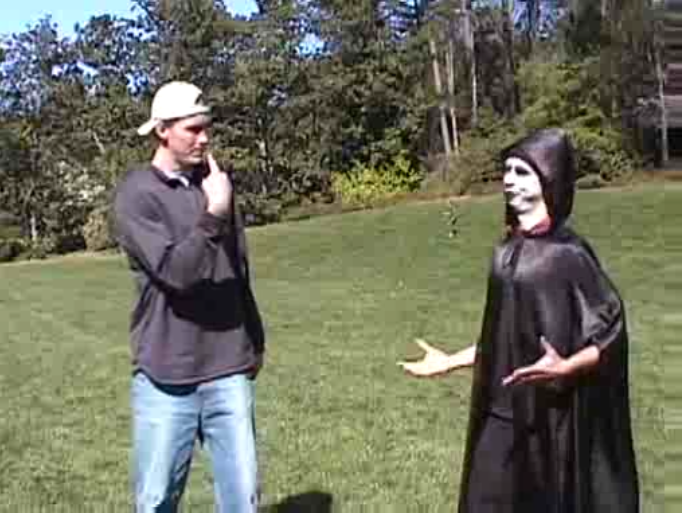
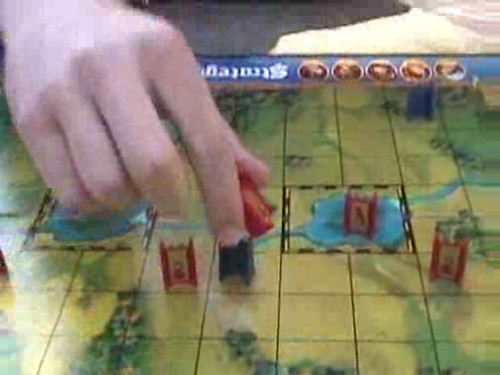
During his time at Duke, Dunleavy was the protagonist in a short-film made by the charitable comedy group Duke University Improv, or DUI for short (avoid the obvious JJ Redick quips. These funnymen do good work. "Humor fighting tumors."). The film was directed by lit it boy, Dana Vachon (hit up Amazon), and heavily references Ingmar Bergman's "The Seventh Seal", with Dunleavy playing Stratego against Death.
Though I know I am merely teasing you with these tales without providing ample footage, in the nascent era of viral video the film remains locked up in the prison of Facebook's privacy settings. Feel free to visit DUI and ask them to (ironically?) Free Dunleavy.
*Cue the Proclaimer's "This Is the Story". Loop the opening chords.*
It begins with Dunleavy seated on a bench in the scenic Sarah P. Duke gardens, foot-tapping and staring off into the distance. His posture projects loneliness, but his demeanor quickly changes when a man in a bumble bee costume and a chicken mascot materialize next to him. They all hug enthusiastically, multiple times, and then dosey-do in the distance. Logically, lollipops are the only thing that can keep up the pace of the perfect day. Dunleavy is happy. What next? Too close for lollipops, switching to ice cream cones. Clearly, Dunleavy is not lactose intolerant as he smushes the soft serve into his face.
Finished with the snacks, Dunleavy discovers fire in the form of bottle rockets. The chicken and the bee rejoice. But, just as the joy from food is an ephemeral pleasure, fireworks soon fade. Sport emerges. Wiffle ball bat swings and a homerun for Dunleavy. Having mastered the game, the chicken suggests kickball. Dunleavy kicks a chunky ball off into the distance, floating into the air...
Death catches the ball. Dunleavy becomes self-aware, or perhaps cognizant of his own mortality, or maybe just sad that the perfect day has changed. Death challenges Dunleavy to Stratego. They play. Dunleavy wins a piece. The bee cries. The chicken sobs, or laughs--it's unclear. They all dance, hand in hand.
I never grew up as any kind of college basketball fan. I grew up in the suburbs of San Francisco, hardly a college town. My dad went to a tiny school in New Hampshire, and my mom went to a small school in Pennsylvania that, when she went there, did not have a men's basketball team or, for that matter, men.
Now I actually go to college, and care deeply about the fortunes of my USC Trojans, although in going from the Golden State Warriors to USC basketball, all the advantages the college game is supposed to have over the pro game-the energy in the building, the sense of kinship with the players, and the feeling that the game is not some pre-packaged industry but a genuine competition in which the players give all that they have out of a desire for glory or pure love for the sport-feel noticeably absent.
Anyways, whereas college basketball was once only an opportunity to evaluate the merits and flaws of future pro players, I now genuinely care about not only the performance of players destined for the NBA, but the play of the actual team, from the future lottery picks to role players, and how they work together as a team in order to win games.
Unfortunately for me, the emphasis on college basketball has shifted in recent years to an extended pre-draft camp, especially since the "one-and-done" rule allowed players who in years previous would have jumped straight to the pros shrouded in mystery to show their skills for a year in the national spotlight, especially when they sign with programs not seen as traditional college basketball powerhouses.
Anybody who watches college basketball now knows of what I speak; about two weeks ago, I watched Georgetown get upset by Pittsburgh, although I only knew that from the score; the broadcast itself taught me about how good of an athlete Roy Hibbert is, how good of a passer he is from the high post, how he can finish with either hand around the basket, and how (I am not making this up) he puts "perfect rotation on his free throws," which is much more important to hear during a pair of big free throws than something like how often he actually makes free throws. (An un-perfect 63.4% on the year, by the way.) I am not exaggerating when I say that when another Georgetown player hit a tough three coming off a Hibbert screen, the broadcasters chose to talk about the screen instead of the shot.
Naturally, what sent me over the edge was when my beloved USC's upset over hated rival UCLA became a five-on-five workout for Kevin Love. While DaVon Jefferson quietly took the Bruins apart, I got to hear gushing monologues about Love's rebounding, post play, outside shooting ability, choice of number (again, I am not making this up-the broadcasters pointed to Love's choice to wear Connie Hawkins' number as evidence of his respect for the game), and especially his outlet passes, which have ignited UCLA's pace of play to 254th in the country.
The best-known example of the player being more important than the game has to be last year's championship game, when the broadcast team raved about Greg Oden for 40 minutes while Florida quietly won its second consecutive national championship.
The emergence of singularly talented players taking over programs and dominating college basketball as freshmen, made directly possible by Carmelo, made possible in theory by Amare, LeBron, and Dwight Howard showing just how much game an 18-year old can have in them, and made real by Durant and Oden, is odd for college basketball, because it has always been a platform where the program is paramount to the individual-like the old saying goes, the only man who could hold Michael Jordan to under 20 points a game was Dean Smith.
For one year or more, top prospects must now show the strengths and limitations of their game, where in the short-lived era of the draft dominance of high school players, we had convinced ourselves that the draft's best players should not have limitations.
Take Derrick Rose. When he was a high-school senior who almost no casual fan had ever seen play a full game, all we knew about Rose was that he had a Baron Davis-like point guard build, and was capable of shocking dunks and bowel-emptying crossovers set to new-wave Europop; that, combined with reports that he was a "true" point guard with surpassing court vision, allowed us to see Rose as a one-man point guard revolution, combining Jason Kidd's size and passing ability with Devin Harris' speed and young Steve Francis' finishing ability.
However, he came to John Calipari's big-time Memphis program, and instead of being allowed to handle the ball on every play or run the pick-and-roll, he's been relegated to being one in a bevy of slashers in Memphis' equal-opportunity speed attack, finishing on fast breaks, making passes when needed, and playing quality defense, doing his job for an undefeated team, and in doing so has become less compelling in the eyes of the draft than Michael Beasley, doing it all for the significantly worse Kansas State Wildcats.
Whereas before college players were seen in varying degrees of good, and teams looked at which one would be most effective in helping their team, with the crown jewel of a draft being a player like Duncan or Iverson or K-Mart, players who had proven themselves to be effective for their teams through countless battles, the phenomena of LeBron James and the rest of the high schoolers and the prophetic choice of Dwight Howard's freakish potential over Emeka Okafor's established game have turned high school superstars with the spotlight of the "one-and-done" year shining on them into team saviors who will all be franchise players.
When those players hint at the possibilities of their game without needing to show the whole thing, like Oden or Marvin Williams, they are free to remain superstars in our imagination and we rejoice. When they dominate with the spotlight on them, like Michael Beasley this year or Kevin Durant last year, the filter of our dreams for them when they were shrouded in mystery and talent makes us see them being radically different from those that supposedly dominated the college game through savvy and skill like Adam Morrison, Shane Battier, or Jameer Nelson, but rather as having possessed so much natural talent that the college game itself bent to their indominable will.
Going back to the UCLA game/Kevin Love-fest 2008, the broadcasters briefly stopped fawning over a Love outlet pass that almost started a fast break to issue my boy O.J. Mayo the ultimate put-down of the "one-and-done" era: "O.J. Mayo is a good player, but he's not a great player." While one-and-done players who appear to follow the paths we forge for them in our imaginations turn from valuable players to gods worthy of clearing out an entire franchise so that their gifts may be better accommodated, those who show a ceiling during their showcase year are punished with a lower spot in the draft and a much lower place in our imaginations.
After Florida's first championship, Joakim Noah was a tremendously athletic big man who could pass, run the floor, play defense, and rebound like a man possessed; in the imagination of the draft, he would one day become a player who would add to those skills 20 pounds of muscle, an outside shot, and post moves, and he was projected as a top-three pick. He chose to stay, and played nearly the exact same role for Florida that he had in the previous year, and the result stayed the same as well; Florida won the national championship. Instead of being rewarded for proving himself as a player who would be an extremely valuable member of any team, Noah ended up going behind not only the sure-thing foursome of Oden, Durant, Horford, and Conley, but Jeff Green, Corey Brewer, Yi Jianlian, and Brandan Wright as well, players who all seemed more attractive than Noah because they had not yet allowed the world to see that their games came with limitations.
While many of those picked ahead of him are crumbling under the weight of what their NBA teams expected of them, Joakim has quietly posted the second-highest PER of any rookie and leads the Bulls in +/- rating. Likewise, O.J. was expected to be an Arenas-like Deus ex Machina of a guard capable of scoring 40 points with a flick of his jump shot and elevating the otherwise offensively-challenged Trojans to greatness through the sheer virtue of his game; instead, he has accepted his role on a grind-it-out Tim Floyd team that is a top-5 defensive team in the country, and instead of freewheeling on drives and fast breaks patiently runs off screens looking for a jumper or bucket off a curl, gradually settling into his role as an efficient scoring option. Like Noah, O.J.'s performance in college strongly suggests that he will contribute rather than dominate, and as this fails to jibe with what he was expected to be given his status as a phenom since he was a freshman in high school, he has dropped out of most imaginations, and hence has dropped out of many top 5s.
By definition, greatness cannot be so common as to present itself in three or four players every year, but in an era where we have become spoiled because of the influx of incredible young players in recent years, the mystery-shrouded scraps of wonder we get from fawning scouting reports and fleeting YouTube clips about the one-and-done wunderkids lead us to believe just that, and hence we trip over ourselves to anoint those who appear to fufill the destinies we have laid out for them as the next Michael Jordan, as well as condemn those who prove themselves merely human, but if NBA teams learn to temper their expectations for the men in the spotlight and see one-and-done phenoms as players capable of being a part of the answer rather than the answer itself, they may find the sublime in the simply good.
UPDATE: I'm just as devastated as the rest of you by the Shaq news. I've never believed in Stern conspiracy stories, but this does make Wade relevant again, puts a big, fat marquee name on one of the young and exciting teams that the league believes should merit more attention, and the chances of a Shaq-Kobe playoff series just went from "completely impossible" to "fairly likely." I'm fucking stoked for this-I see it as either going down like Ray Allen destroying his dad at the end of He Got Game or Darth Vader finally killing Obi-Wan Kenobi, with Kobe punctuating a 40-point game with a vicious dunk over Shaq as Shaq walks to the bench with a serene grin on his face when Boris Diaw replaces him and the Suns go on to win the series. I just don't see a lot of explanations for this-could Marion's attitude really have been worse than Scottie Pippen's, who was at open war with the Bulls organization but was ultimately able to man up and win a championship? Steve Kerr was on that team. And the idea that this was done to protect against the threat of Bynum feels like when the military resorted to activating SkyNet to control the giant computer virus in Terminator 3, which led to the immediate immolation of most of humanity. I'm with those of you hoping that the best outcome of this is that the whole thing goes down in horrible flames and a revolution springs anew from the ashes.