12.10.2010

Pinata Tied and Golden

sized_New Picture (16)

I wrote a thing for FanHouse this week about the very, very serious man Ron Artest has become. You should read out, but here's the gist: Ron Ron was once taken seriously in a bad way, then became a harmless joke, and now, through his advocacy of mental health issues, has once again turned his persona into something that matters. Reading yesterday's Marc Spears column on Gilbert Arenas, these days, I had a similar thought.

I've been understanding this season's Arenas as sad, sunken epilogue. The quotes he gives are, for someone who had so much invested in his days of might, heart-rending. Even his description of himself as "controlled chaos" from the beginning of last season -- which at the time, seemed forced and unhappy, and soon thereafter, the worst kind of irony -- now makes me smile. That's what Gil did at his peak: he made us smile. When he describes himself as an entertainer, it's not in performative, WWE-sort of way. Rather, he was a play who, through basketball, could remind us of that part of brains that's there to be tickled and confounded. "Enigmas" in sports are troubling if the game is an equation to be solved. We know it's much more than that, though, and so the 2002-2007 Arenas can never be erased.

Wipe that tear away. We had a while with him, and while it would have been great for Gil to keep it up forever, at least he gave us (and got) that five-year joy ride. The more I read of him these days, the less I think he needs our pity. Sympathy, maybe, but we should take note not only of the fact that he's changed, but that -- unlike in other comebacks -- he's fairly comfortable in what he's become. Maybe it's resignation, and yet there's no question that Arenas has assumed a new role in the grand scheme of the league. Not necessarily wise, or entirely disinterested, he has the perspective that comes only with losing it all and then piecing yourself back together again. No question, ruminative Gil is a function of circumstance. But there's something Sheed-like about statements like:

“When a young guy is coming in, the older guy never wants to move over,” Arenas said. “But I know my time here is over [as the face of the franchise]. I messed up my legacy here"

“It’s still basketball. The rules don’t change for the bench players. I learned a lot from the whole Iverson experience. Not get a job because I can’t adapt to my environment? I’m sure I can adapt to any environment.

“In this league there is no such thing as long-term anymore. Players are getting shipped out and shipped out. I’m looking at the Kings like, when I first came [into the league], none of those players were here. The Lakers team, the only person that was there was Kobe [Bryant], and Derek Fisher came back."


Arenas is resigned to what he's become. In that, though, there's also resolve -- resolve to not only make sense of his situation and find a realistic path forward. More importantly, these are hard truths about the league, ones we could stand to here. They're certainly useful to have out there in public, probably even for younger players to hear.

Sports radio loves to talk about players who "get it". In that universe, Arenas never did "get it". Now, he "gets it", except "it" isn't about killer instinct or locker room chemistry. He never really did play by those rules -- he was "an assassin" to the point of absurdity, and we all know what his idea of a lively locker room led to. That doesn't mean, though, that others can't learn from him, whether or not they brought a Desert Eagle to the Verizon Center. Gilbert Arenas says these things not because he could give a fuck less, or in hopes of making us all weepy on his behalf. He does it because he doesn't have any choice. He's always been incapable of self-censoring, and perhaps was a bit too honest at times. The difference is, these days there's real substance to what he's selling.

Labels: , , ,

11.07.2010

You're Promised the Honker

Chaiten Volvano

The following is not intended as a defense of Jay Caspian Kang's post on Kevin Garnett. Mr. Kang is a quite able-bodied young man and can speak for himself, in these parts or elsewhere if he should so choose, whenever he so pleases. Nor is it any sort of attack on the man they call Rough Justice, who has contributed to FD in the past and is, at There Are No Fours, a writer you should digest on a regular basis.

That said, I would like to take some of this quality 6AM airplane time to address RJ’s post from yesterday, where he lashed out at Jay’s Kevin Garnett post and raised some broader critiques of the FreeDarko way of life. Let it first be said that my feelings on Garnett-Villanueva are uncharacteristically murky. In a purely ethnographic manner, I dismissed CV’s tweet-borne outrage as “just not the way things are done.”

I wasn’t only the writer to say, in not so many words, “come on Charlie V., WE PLAYIN’ BASKETBALL!” Rather than take a moral position, I was content to relativize, or romanticize, or whatever, and say that sports are awesome and athletes, subject to more special rules than the rest of us, even when it comes to the expectation of half-decent conduct. I heard from readers who wondered why the near-rampant homophobia of sports wasn’t somehow entering this discussion; in talking with Jay, I started to think that here, Garnett was the exception that proved the rule.

There’s a lot that can be empirically, and affirmatively, chalked up to the culture of the sport. When is trangression transgressed? When, as in this case, the speech-act is both resoundingly dull and just plan mean (as in petty). The common currency, or rules of engagement, is all about drive, rancor and wit. Going too far and not going far enough are strangely intertwined.

As for Garnett himself, to call his intensity performative is by no means to discount it. If KG is one-hundred percent authentic – which, mind you, is different from sincere – out on the court, he would be almost alone in sports. Part of playing the game is playing the game, playing mind games, and any other such cliché you can call up to register the duality that is the competitive self. If you hate that sentence, just say “nature and nurture” three times fast. Garnett, like pretty much any other person looking to topple others in his field, is closed loop with no beginning or end. He wouldn’t be driven to so fastidiously project the character he does if he weren’t, on some level, really that hell-bent on succeeding. Yet as the Recluse suggests, KG’s allowing himself to be so swayed by lawless emotion is easily attribute to Jordan-era basketball socialization. From there, though, we’re right back at “but it takes the right kind to so totally embrace, and even further amplify, the lessons of MJ’s persona”.

blur

I can quite artificially pick and choose what Garnett traits to admire, or at least enjoy -- cussing at no one in particular, banging his head on the padded goalpost, needlessly blocking shots after the whistle, barking like a dog, and slapping the floor on defense for no other reason than to fire himself up further. That John Thompson interview, the “loading up the clip” sound bite, and that dolorous adidas commercial with the stand-up comedy section, these are all pure gold to me. Yet that’s a false dichotomy. These are part and parcel with the bullying, dirty play, and complete and total loss of perspective while on the court that increasingly, have become the hallmark of Garnett’s on-court demeanor. Part of it is the move from Minny to Boston, which got Garnett out from under that all-consuming cloud of pathos and made him less eternally sympathetic and – since he was suddenly playing on a real team – eccentric. Going from feel-good super-team to brooding contenders further concretized Garnett. You just couldn’t look at him any more as a powerful, twisted curiosity. He was out on center stage, and then after 2008, a professional who didn’t care to leave room for our indulgences. Getting older didn’t help, either.

That’s to say, I neither quite agree with Jay, nor with the part of me that could once be brought to tears by a 2002 shot of Garnett guarding Webber. Before, Garnett was an extreme version of competition with no object. Once he got a taste of its applications – the only role that would ever make sense for him, long-term – he changed, but our perception changed, too. The KG of Minnesota was a parable, a folk hero, a creative act that drew in athlete and fan alike to create mythology. He was perfect for the purposes of this website, but I can’t pretend he wasn’t kind of a dick all along, or that the way he looks in this second act somehow stands apart from the earlier KG. What I’m learning now is that I’m stuck with both, and that they’re actually one and the same.

Much of Rough Justice’s post was directed at Jay; I may have indirectly addressed them, but the point here isn’t to rush to the aid of the last thing published on this site. What really interests me is RJ’s assertion that liberated fandom and team faithfulness are not mutually exclusive. To this I say, duh. To be perfectly honest about it, the “manifesto” in our first book did the concept of liberated fandom a great disservice. I was only barely responsible for it; it was put together by forces beyond my control, and I was too busy to complain that it tacked way too extreme for my part. Plus, I heard it would help sell books.

On this blog, I have never suggested that liberated fandom meant players over teams, or that pure aesthetics are all that is to be gleaned from basketball. What excites me about basketball is that, at its best, a team is not only the sum of individuals – it has nearly the same amount of personality. Furthermore, winning is always a question of aesthetics, and aesthetics employed primarily in the service of winning. It’s the interplay between these two poles that, to me, exemplifies the NBA. And while I’ve always scoffed at being chained to a single team, especially when players shift around so much, I’ve always taken it as license to have a rooting interesting in a bunch, with one or two sometimes elevating themselves above all others. Granted, oftentimes my more casual interest in a team is a function of a player or two, but for what it’s worth, I’ve always been known to turn my back on individual players. In short, liberated fandom is more like free love than a weird fetish, or unlimited free porn downloads.

lif_06RubberStamp_01.jpg

That’s all I have to say on the subject for now. There is precious little rock in my iTunes. I have some thoughts on legacy that I’ve been meaning to get up for a while now, so let’s so how bored I get on this next flight. The television isn’t working on here but I wasn’t expecting it in the first place.

Labels: , , , ,

6.29.2009

Toss Off Those Glittery Outlaws


So that's how I found myself in the position of reputationally damaging one of my favorite players.

On Saturday, when the sun should've been setting and I should've been buying chicken broth, I ended up having an impassioned phone conversation with Chris Littmann over those Jennings/Budden tapes. I hadn't taped them off the original camera feed, or put them on message boards, hip-hip with a trace of Knicks, in the first place. But we were in a position to, as the kids say, blow up his spot in a major way. The question was, how to do so without coming over as prudish, judgmental asses who don't actually like getting to hear players really, truly be themselves.

I think we—well, actually, Chris—did a good job softening, or ambiguifying, the blow. But the fact remains: The Baseline, formerly known as the mainstream media outlet most devoted to Jennings cheerleading (and Rubio-hating), was now spearheading the movement to get out some quotes that, in the hands of the stupid, would further tarnish Jennings's already tricky image. In the past, I'd resisted putting up incriminating Twits, Here, though, I thought of throwing these videos up on FD before the whole prospect of going platinum with them came up. For anyone with half a brain, or half a clue as to how NBA players—especially an outspoken nut like Jennings—would talk in a "safe" situation, these are gold.

Are there people too foolish, or walled-in, to not catch the obviously whiff of absurdity and playfulness in everything Jennings says here? Of course. Should I spend my whole journalistic life dancing around these assholes with kid feet? I don't want to. To me, Jennings follows naturally from Beasley or Arenas, both of whom are distant descendents of Muhammad Ali. They talk. We listen. They do or don't back it up. But we listen because we know they might.

The reason we ultimately went big-time with the story was the abrupt cover-up/misunderstanding/Twitter shutdown surrounding it. As Chris said in his post, we like seeing this side of players. But it's not clear the players themselves have really thought this "people want to see the real me" thing through all that well. Most importantly, are they supposed to be showing us the edgy outskirts of their public persona, or the first shores of who they really are? That is, are Twitter, or presumably ephemeral, semi-private (if you don't know. . . ) camera feeds, meant for the hardcore fans who just want more, more, more content, and will tolerate some rough edges—or those so in tune with the player that they actually "get" them?

Ghosts

It's clear that ballers understand the marketing potential of Twitter, and recognize the authenticity factor contained therein. But again, are they supposed to just do them, and let the interested public see a little, or learn a whole new set of rules for how to reveal layers of their persona that are off-limits in press conferences without having to stage a Cultural Translation 101 seminar on the internet? Check out the Wade Twits in the Baseline post. Hard to see these utterances as anything other than Wade ignoring the public, or figuring anyone watching his Twitter exists in some sort of idealized fan vacuum. Either way, the question of audience, and public presentation, has gone out the window. That must be liberating—not just to get to say whatever, but to know there's an audience for it. But exactly waht "say anything" means remains to be seen.

As we can see from the deletion of Jennings's Twitter, it's not like agents know exactly how to deal with this newfound questions of real/too real. By its very nature, athlete social media should push the envelope a little. Remember Arenas's blog, anyone? However, that was far more mediated, vetted, and no matter how renegage it seemed at the time, a so-called "underground" version of the Arenas emerging in the press. What Jennings or Wade is saying here is irreconcilable with their mainstream personas. It forces us to acknowledge who these players might really be—a "real" that's only terrifying if you're incapable of reading "fuck the Knicks" as anything other than an off-hand joke.

So consider this a challenge not to players, but to fans, the media, and agencies. These guys want to put themselves out there. Clearly, it's seen as an opportunity for them to be themselves, in a way that the strictures of modern marketing doesn't allow for. How to reconcile this behavior with the vanilla image that moves real money? Where's the ledge? Amidst all the juvenile finger-wagging that will spring up around these Jennings comments, I want to know what's next: What happens to those of us who want to hear raw and uncut Brandon?

2681499866_6f03cc4e25

LIke I said after these broke, if only Jennings had cleaned up his language a little bit, this could've been viral gold and an absolute marketing coup if the plan is to sell his Hollywood persona as something for the next generation. As it is, we're plunged right back into some of the most tired culture wars, or even clash of basketball civilizations. When that clucking clears away, though, it's up to young players and their management to figure out the new rules for unfiltered interaction with their public. At least that way, maybe the rest of the world can learn the difference between Jennings acting out and the rookie PG really sowing the seeds of discontent.

Post-script worth noting: It appears (from what we're hearing) that Brandon himself pulled the Twitter page. Maybe it was reactionary, preparing for the worst from all other parties involved. But certainly, this indicates that even this most "naive" of social media doyens realizes he needs to regroup and figure out what balance to strike.

(Working slowly toward a Suns post. Maybe we'll wait to see if it actually goes down.)

Labels: , , ,

9.04.2008

Guest Lecture: The best sermons are lived


We're taking a break from politics for a moment and getting back to the world's greatest sports league, with a closer look at a fascinating development in the history of a fascinating player. This special guest post comes courtesy of bona fide comic book geek Eli Gunn-Jones. But, as the title of this post indicates, we're still watching the convention, and if anything crazy jumps off, you know we're going to be all over it.

A few weeks ago, Kobe prepped for his thirteen-hour flight to Beijing by making an after-hours pit stop at a comic shop to foster his new graphic novel hobby. Boldly proclaiming that he is “into that dark shit,” Kobe allowed the flabbergasted store clerk to steer him towards Garth Ennis’ brilliant, twisted Preacher, new-age noir 100 Bullets, along with a collection of Alan Moore DC Universe tales, among others. If Kobe is the most intriguing figure in basketball, it's largely because of his highly polarizing persona, an all-encompassing public guise that often overshadows, or creeps into, our appreciation of his transcendent play. Condemnable man that chased affable Shaq-Fu out of town, or misunderstood hero who could no longer take The Big Aristotle’s obnoxious postulations? Baller who will never measure up to Jordan, or relentless worker who’s left an undeniable mark on the NBA? Sexual assault-prone scumbag, or repentant man who made one mistake? The sheer volume of controversy Kobe creates is breathtaking.


While the stanch comic connoisseurs among us could argue into eternity whether Kobe’s selections are FD or not (Dark Knight Strikes Again? What is that, post-irony?), the man’s choice in graphic novels is an eerily fitting representation of his duplicitous nature. Ennis’ modern day classic Preacher is rife with the sinister adult material that Kobe professes to enjoy; it follows Jessie Custer, a reverend grappling with his nonexistent faith in God when the spawn of an angel and demon happens to escape from Heaven and merge with his soul. The battle between ultimate good and pure evil within a human body fits Kobe almost too perfectly; part disarming gentlemen, part ruthless egomaniac, but the two opposites somehow manage to complement one another. Most of all, Preacher has a wicked, cynical sense of humor that Kobe must have developed, or at least undoubtedly learned to appreciate, after spending so many years in the unforgiving, harsh spotlight.


Meanwhile, the sheer brilliance that shines through in Alan Moore’s wide-ranging anthology of stories resonates with Kobe’s dizzying command over the basketball court. Kobe’s purchase contains lesser-known stuff: a few Superman yarns, a cutesy Green Lantern one-shot, the obscure Vigilante. No big names like Watchmen, but definitive proof of Moore's ability to impose his will upon the medium like no other. This trait is akin to Kobe's versitale hardwood talents: he fluidly transitions from team distributor to at-will scorer, from affable teammate to lone wolf with a vendetta. For the sake of argument, let's conjecture that Kobe feels a half-realized, hazy kinship with Moore for their common ability to implement the endless array of styles at their respective disposals.

But, per usual with No.-8-turned-24, the ultimate question is one of intent, and the answer makes all the difference. Why has Kobe turned to graphic literature? Does he fancy himself a real-life hero, valiantly coming to the rescue like Spidey swinging in on a webline? Is he drawn to the mature, shadowy material because he's a closet sophisticate with a taste for moral complexity? Or, as the detractors would surely argue, is it a reflection of his pitch-black heart? Or, maybe this is classic front-running, with Hollywood’s parade of blockbusters having piqued KB24's interest in the source material.

But regardless of the motivation, it leaves us all scrambling for an explanation, one that falls back on old assumptions as it reassess them. The comic store clerk’s account is so enthralling precisely because it is both unexpected and refreshing. The greatest flaw of Kobe’s personality, and many superstar athletes for that matter, is the constant aroma of fakery. The transparent press releases, the phony smile-filled interviews, the camera posturing with his adorable daughters—it all comes off as a giant façade. Nobody has a clue which of those characters, if any, is the real Kobe. Which is why, like that candid video of some Team USA players eating at Wendy’s, the notion of Kobe arguing the merits of his favorite Green Lantern or geeking out over Joss Whedon’s stint on Astonishing X-Men, however unlikely, is so appealing.


Baron and Nash’s beach love affair was exhilarating to behold, and these two PG’s are so popular both with casual fans and die-hards because they exude a rarely-witnessed candid sensibility. They are affable, off-kilter, and most importantly, relatable—unfortunately, the exception rather then the rule with hardwood professionals. A short anecdote: I once found myself face-to-face with BD and gushed that his dunk over Kirilenko in the playoffs was the happiest moment of my life. Hyperbole if there is ever an example of one, but Baron responded with a wide, bearded smile and an unsolicited hug.

I picture a hypothetical encounter with the Kobe’s and LeBron’s of the League playing out quite differently. Maybe a forced guffaw and polite fist pound, ready to move on from this forgettable encounter the moment it begins. It doesn’t make them bad people; God knows they need to develop a filter in order to deal with hangers on, shoe execs, industry sharks and the like. But it sure as hell makes me curious what’s hiding under the tarpaulin that makes up their guise. Which, coincidentally, is a cause that falls in step with the loosely defined parameters of FD-ness. That's why Kobe's jaunt into the comic shop is more than mere trivia: It is a glimpse, however fleeting, into the true personality of an otherwise-enigmatic star.

Labels: , , , ,

8.28.2008

The Beasley Postulate, Extended

I was so serious when I said it: This is now a politics blog. Why else would we have covered a veep acceptance speech? Therefore, it with great importance that I command you to watch this video Chris Bosh made for FanHouse, of him and the gang eating fast food:


A few weeks back, I posted some image-defying, at-home footage of porn stars, and wondered what such a thing might do for NBA players, and if it ran too counter to the interests of branding and such. Well, here it is. First of all, this is stunningly mundane. And yet, you're still struck by the sheer presence of the scene—LeBron James, Chris Paul, Dwight Howard, and Deron Williams, sitting at one table like it's nothing, millions of dollars and thousands of win-shares kicking it in front of, as Bosh note brilliantly, a wall of Penzoil. They come off not only as less serious and polished than we're used to seeing them—why wouldn't they, since this is their world, not the media's—but they also come off well. This is the most loose and amusing we've ever seen LeBron; weirdly, it was the acting of the "The LeBrons" that had previously seemed like the most authentic Bron we'd seen. I guess the common thread is humor and goofiness, which are largely absent from the King James we're sold.

But I'll be darned if this doesn't make me like James a lot more, and realize that underneath all the stone-faced professionalism, this is an outgoing young man having the time of his life. We can pretend that sports are war, or the measure of a man, or something whose true significance fans, and not players, are responsible for generating. However, who exactly relies on this construction for their interest? Does the demographic whose name is synonymous with the mention of "demographic" in sports want a stiff upper lip, as opposed to this window out onto levity and entertainment? I guess that (as it would be for the Nautica Thorn example) it's a slippery slope into all the old stereotypes of the modern athlete, and an evocation of Johnny Unitas's flat-top and the brow of Dave Cowens. I keep wondering, though, if 25-34 year-old males don't at some point catch up to the athletes of this era, or maybe even find themselves relating to exactly this capacity for frivolity.


Of course, this stuff lives on the internet for now, when we actually do get to see it. And I don't mean on-set bloopers, unless it's that batch of Iverson that got pulled off of YouTube after a few days of existence and never returned. Still, this shit is real, and people respond to it. It may muddy, or make slightly more complex, our picture of an athlete—or a candidate. But in the end, having us feel there's a real person underneath the professional feats, one that informs and infuses them with our common humanity, is worth the sacrifice. Instead of trivializing our fandom—or political allegiance—it engages us, turns us into more than circuits responding to cues and unrewarding, rote narratives. If we don't expect it, and the powers that be don't think we want it, the cycle can be broken and life will be more interesting for all of us. Unless I'm grossly wrong and a lot of people do need their athletes, politicans, and porn stars to be a series of accomplishments surrounded by formulae or talking points, nothing more and nothing less.

But seeing as this tincture of personality is what makes for Obama's appeal, and it's what made McCain's name in 2000, you'd think this charisma would have some recognizable value. It's only a matter of time before sneaker companies realize this, and hopefully, this election will hammer home that point even further.

P.S. Tum Tum=official Redeem Team soundtrack

Labels: , , , ,

7.17.2008

My Interview with Nets Rookie Anthony Randolph


It's too chilly up here for me to watch the summer leagues, and plus, those are perfect examples of basketball that means more to me as a box score. Like a young Andre Miller, as we've discussed before. Incidentally, before you rush to label that po-mo and crazy, remember that your father's father followed a lot of the American League in much the same way.

Instead, I've decided to do part two of what I started on Monday: Plainly stating our basic tenets with a clarity I never could before, and then wondering how true they really are. This is both an attempt to rescue the site's distant past, and to prove that, despite all that shrieking during the Finals, there is peace in the valley and no one need turn in their decoder rings just yet.

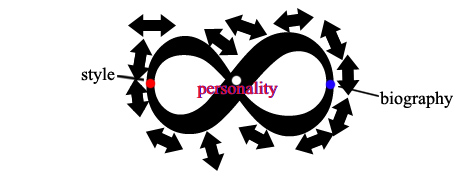
Long ago, when names like Rocco, Brickowski and Ken roamed the comments section, I did a post about the link between style and personality. I probably oversimplified it at the time, so here's what I wish I'd said: The style a player develops, both as an abstract ideal and as a process of work on the ground, is a function of his personality.

Yes, his physical abilities and needs of his team figure into it, but for it to achieve any unity, any identity, there has to be a nexus of his sense of self and his game. One that, while essentially symbiotic, can slant one way or the other at various points in time. At the same time, there exists a similar bond between personality and biography, which—almost done here—means you end up with a system of mutual construction that involves all three elements.

Diagram, by Tom Ziller:


But looking back at this pivotal FD moment today, I'm a little embarrassed by how over-credulous this model is. Certainly, we know a lot about players, and can gauge something of who they "really are." Then, there's also all sorts of misinformation, spin, dissembling, and empty utterances. It seems like, if we want to salvage this at all, we'd need to either replace "personality" with "persona," or better yet, insert the latter as a qualifier on the former, with the "personality" hovering out somewhere unknowable that involves Kant and outer space.

Tidy and dogmatic, I know. What I'm wondering now, though, is if, while the nexus of style and personality remains utterly individualistic, the basketball acts that make up "style" are a lot more generic. The minute touches and details that FD hangs on are the intersection of style and personality; it might make even more sense to say that "style" is that intersection, and "basketball acts" is one node. Like there could be two combo guards with, for all intents and purposes, the same approach to the game; however, the tone would be totally different because of personality (and biography).

Why am I doing this, and why do I refuse to say anything concrete? Because, duh, I'm talking about Kobe. What's the oldest argument in the world about the man: Gorgeous game, awful person. And while certain aspects of who he is seem indispensable to this basketball force walking on earth, they are only so subtle: Work ethic, intensity, arrogance, sense of history, capacity for abstraction in all manners of life and job. I don't think that really captures the Kobe Bryant we bicker over all day. But at the same time, it's tough for people to separate man from game. There's something about the tone with which it's carried out that keeps the two stuck together, facial expressions and body language that may not register as basketball acts but nonetheless infect perception.


I understand you, now understand me. This same thing accounts for my extremely objectionable feelings on Garnett, but in a totally different way. KG was once the absolute standard-bearer for this way of understanding pro athletes. For whatever reason, it feels to me—again, as a purely subjective viewer of the sport—that these connections have slackened, or weakened. At the risk of making this even more confusing, he now plays a less subjective game. I'm not saying Kevin Garnett the man has been diminished, just that his play doesn't crackle in the same way. He does a lot of the same things, just with a different feel. It makes perfect sense if you think about his age, his weariness, all the frustration and scrutiny he's faced.

This may or may not have helped him win a championship; who knows if Kobe should pay attention. But I'm beginning to think that, when we're trying to understand our likes and dislikes around the league, we need to think in terms like these. Because it's simply too simplistic, and boring, to focus our feelings on the elements without trying explain how they work together in our minds to create these semi-mythic pop figures.

Labels: , , , ,

6.25.2008

How Many Angles in a Vortex?


Note: I've got a new Sporting News column on the draft and gender, or something. This is longer.

When we were batting around draft ideas, Ty Keenan suggested that Mayo (and to some degree, Walker) were in the unique position of having their value peak, crash, and then rise up from the ashes in redemption—all before the draft prognostication even really got under way. We all decided that this was a function of undue hype, a circumstantial shutdown of the wild and woolly HS days. They had to come crashing down before, in this new climate, either could be viewed fairly. And then, the positives stood out again, the very ones that had set them on a pedestal in the first place. This is rational, folks, if a little awkward.

But the Michael Beasley's ride through the pre-draft rapids has been a lot less transparent. Even heading into the NCAAs, most people had Beasley penciled in at number one. Sure, there was the shady recruiting stuff, that WaPo piece, and rumors of a bad attitude and poor work ethic. Yet his one-and-done campaign had been such a freight-train of talent, his game so insistent, and so much of the negativity quelled by his on-court progress and words from the behind the scenes, that Beasleys PR problems seemed a thing of the past.

THEN: Rose's tournament ascendency, the "character issues" revisited as the draft became more real, and the lukewarmness of Paxson and Riley. Suddenly, Beasley was again a bad seed, this draft's problem child, Derrick Coleman redux just waiting to happen.


Or was he? In a blink, Beasley made his now-famous "I'm just a kid" comments. Was he dead serious all the time? No, but he'd probably grow out of that, and anyway, wasn't it his right to have a personality? This site and others rushed to brand him the new Gilbert Arenas. A vote for Beasley was a vote against staid hypocrisy, against buttondown orthodoxy in the way the NBA treats and represents its players. He became a martyr, fighting valiantly—if somewhat obliviously—to let players be themselves, to allow them to grow up in public instead of damaging them by expecting too much, too soon. Where Kwame Brown lay in a lifeless heap, Beasley planted a tree and saw it flower.

Stay with me here: The backlash was that, fine, Beasley's a kid, and a light-hearted one at that. And yet the truly elite teens—like, for instance, his best friend Kevin Durant—have that inner fire evident from the get-go. There are growing pains, even moments of weakness when the weight of expectations causes buckle. However, this line of work means working past these episodes, not glorifying them. Riley's disdain for Beasley's goofiness may have been an overreaction, and perhaps too moralistic. However, Riles does know basketball, and whether or not Bealey was defiling the game, it's safe to say that a failure to keep a straight face in the workout told us something about Beasley's disposition. Not a bad guy, but a space cadet, which sometimes seems like a liability in, say, Arenas.

At this point, there was talk of Beasley dropping to #3, or at least being dismissively traded by Miami (way to keep that chip shiny!). And thus, another trope of Arenas reared its head: The feisty underdog. Damn it, Michael Beasley would prove the likes of Riley wrong. He would tear up the league, and show the establishment how wrong it had been to ever doubt him. That's why you have ESPN picking him to blog his pre-draft experience, as well as make short videos brimming with both vitality and slightly unsettling unpredictability. The cult of Beasley was in full swing, and somehow, was as much about sympathy, a feeling for the warm and fuzzy victim who just wanted to have fun, as the bad-ass he portrayed on the court.


There was an imbalance there, and it's being corrected now. As of today, Michael Beasley isn't the king of the freaks any more, he's a misunderstood People's Champ who, when you get down to it, is all about wreaking havoc on the court. All the silly stuff, that's a most elevated version of swagger, pitched so high and relentless that resolves into a reckless calm. He's Amare, and maybe even The Wire's Snoop. Beasley will be on a vendatta from the second he hits the court, one without any of the eccentricity or elegance of Gil's. There will be dunks, and blocks, and threes over unsuspecting PFs. In terms of demonstrativeness, Garnett had better watch his back. He'll be a sneaker magnet, in part because he's a laugh riot (PREDICTION: If he went Nike, the ying/yang ads with him and Durant would be instant classics), but also because of the dynamism of his game.

Here's where we hit the inevitable question: Who is the real Michael Beasley? Of course I don't really know, and with someone who hasn't even hit the league yet, there's that much less to go on. But I suspect he's a combination of all these things, a series of contradictions—some imposed upon him, some stubborn and internal. It's a testament to his charisma, or maybe just the laziness of a media that has covered him like a political candidate, that he's been subject to this parade of monolithic characterizations. He's an icon waiting to happen, but paradoxically, we might have to settle for one with murky edges. In the two months since the lottery, Beasley's already gone through a Bowie-like parade of makeovers. That has to be reason to stop and reasses our mode of judgment.

What's more, there obviously a connection between these conflicting perception of him and his game. No one's labeling him a tweener, but Beasley's hardly getting the kind of "change the game" love that fell Durant's way. And yet, is he any less confounding, or versatile, a player? Sure, he can't play guard, but he's already more physical than KD will ever be. I don't want to say that the uncertainty his style causes has created a persona in flux, but it's pretty safe to say that the inverse is true. And that, if there is some chicken/egg at play here, it might be a long time before these questions get settled.

Labels: , , , ,

6.20.2008

Murky Invasion


The Official FreeDarko Mock lurches toward completion. ETA of this afternoon, maybe willing? In the meantime:

-In case you're still seething over us and the Celtics. . . lap up this latest Quotemonger. There are Green Guys in it, but I think I'm pretty fair and friendly.

-Getting an email from Keith Olbermann was really rad, even if it forced me to admit I'm full of shit.

-Yesterday, I took a look at a certain plaintive Garnett commercial and found myself affected as ever. Dr. LIC claims that this, more than anything else, makes him feel happy KG got the ring. I can't decide if the sadness it visits upon me is about Garnett's lasting pathos, or missing that pathos, which would be a little weird and mean.

Then, I started digging up some of the classic Adidas ads from around that period. Shit was really weird, and pretty visionary. The T-Mac/Clipse joint? McGrady with wings and flame? The Infinity Gauntlet-like one with Duncan, McGrady, and Garnett being built in an ethereal workshop? And then, it turns to the Basketball Brotherhood, which is about as down-to-earth and de-fantasicized as these things get. I'd call that the 2007-08 Celtics of brand strategy.

Nate Jones and I were talking about the sneaker game yesterday, and he suggested that Adidas decided to brand itself and go from there, instead of developing their unique players as brands. The former makes sense with Duncan and Billups, but Garnett and T-Mac certainly lend themselves to the latter—what Nike's done with Melo some (B.More), and, remember, what made Jordan such a revolution in the first place. Nate submitted Arenas as a step in the right direction, but I think that went too far. Those shorts were more likely to make you eat your shoes and set money on fire.


Randomly, this is where Beasley comes up. He's going to be a star, and has absolutely indomitable personality. I can't imagine anyone keeping a straight face as he gets squeezed into the template of Brand Jordan drama and honor, or Adidas's sentimental grind. Seems inevitable that a brand would have to break tone with him.

Oh, and more Beasley: This him to the Sonics possibility has to count for something. If any team is in a position to get the real story on him, it's Seattle. Plus, if you figure Durant's going to resent ownership at some point soon, and will likely leave when he can. . . all that changes if they bring his best friend on to form a ridiculously awesome tandem of contrasts and versatility. Despite my hatred of Clay Bennett, I would buy some season tickets if that came to pass.

Labels: , , ,

2.11.2008

22 People Doing 21 Things


The question was asked: "How can I read only your stuff at The Sporting Blog?"
The answer: THIS

Now, a new feature called "What do you think?" Why are so many centers technology buffs? Tell me!

Labels: , , ,